
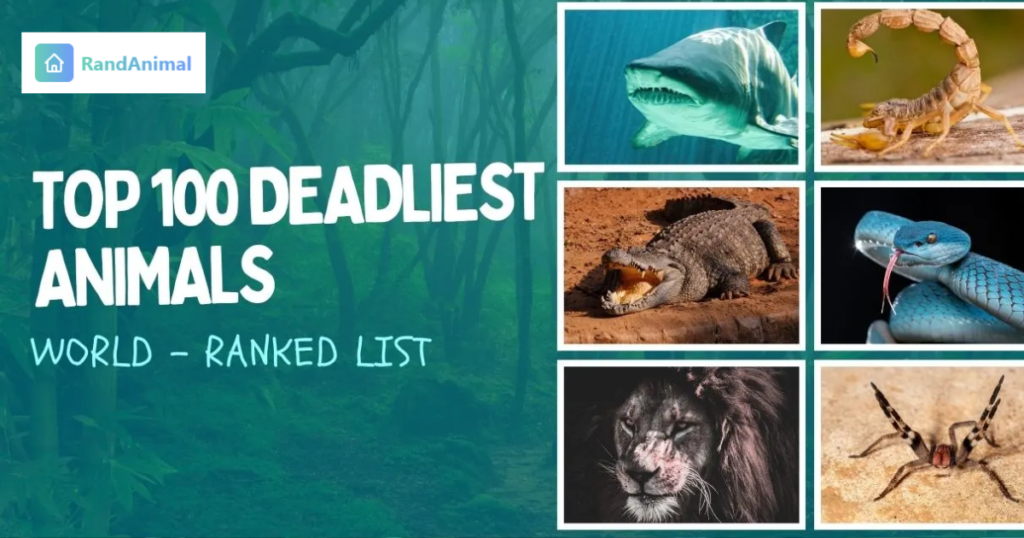
When most people think about dangerous animals, they picture lions, sharks, or maybe a venomous snake. Hollywood has done a good job of making us afraid of things with big teeth and claws. But the truth is very different. The animals that kill the most people every year are often tiny, and many of them do not attack you at all. They spread disease, release venom, or simply charge at you without warning. This article looks at the ten most dangerous animals in the world. If raw physical power is what interests you, you might also want to explore our breakdown of the animals with the strongest bite force in the world.
1. Mosquito — Around 760,000 Deaths Per Year
The mosquito is, without any doubt, the deadliest animal on earth. It is not dangerous because of any physical strength. It does not have claws or sharp teeth. This is very dangerous because it carries diseases from one person to another. According to Our World in Data, mosquitoes kill approximately 760,000 people every year. Over 80% of those deaths come from malaria alone, which is spread by the female Anopheles mosquito.
Malaria is especially devastating in sub-Saharan Africa and Southeast Asia. In 2023, the WHO recorded nearly 597,000 deaths from malaria worldwide. Beyond malaria, mosquitoes also spread dengue fever, yellow fever, the Zika virus, and West Nile virus. Many of these diseases target children. A child in rural Africa has a far greater chance of dying from a mosquito bite than from a lion attack.
Some people argue that mosquitoes have killed more humans throughout history than all wars combined. While the exact number is impossible to know, what is not in doubt is that this tiny insect remains our biggest biological threat today. The World Health Organization continues to classify malaria as one of the deadliest infectious diseases on Earth, with the highest burden falling on children under five years old in sub-Saharan Africa.
2. Snakes — Between 81,000 and 138,000 Deaths Per Year
Snakes are the second biggest animal killers of humans. According to the WHO’s snakebite factsheet, between 81,000 and 138,000 people die from snakebites every year worldwide. On top of that, around three times as many people survive bites but are left with permanent disabilities such as amputations, nerve damage, and lasting pain.
India suffers the most. A major study published in the journal eLife estimated that India averaged 58,000 snakebite deaths every single year between 2000 and 2019. That adds up to 1.2 million deaths in just two decades. The snakes responsible are called “The Big Four” — the Indian cobra, Russell’s viper, the common krait, and the saw-scaled viper. These four species are found in agricultural areas where farmers work in the fields barefoot, often encountering snakes hiding in soil or under leaves.
Wikipedia’s page on snakebite epidemiology confirms that most of these deaths happen in rural, low-income areas where antivenom is not available or is too expensive. The problem is not just the snake itself. It is poverty, distance from hospitals, and lack of treatment.
3. Dogs — Around 30,000 Deaths Per Year
This one surprises many people. Dogs are one of the most loved animals in the world, kept as pets in hundreds of millions of homes. Yet they are responsible for roughly 30,000 human deaths every year. The vast majority of these deaths are not from biting alone. They come from rabies, a disease that dogs transmit through their saliva.
According to Wikipedia on rabies and the WHO, rabies kills nearly 59,000 people per year globally, and dogs are responsible for up to 99% of those cases. Once a person starts showing rabies symptoms, the disease is almost always fatal. The tragedy is that rabies is completely preventable with a vaccine, both for the dog and the human after a bite. The problem is access. Most deaths happen in Asia and Africa, in places where stray dog populations are large, and vaccines are not always available.
According to sources that described a heartbreaking case where a ten-year-old girl was bitten by a stray dog, and her family did not think it was serious enough to seek treatment. She died weeks later after developing full-blown rabies. The vet wrote that it stayed with her for the rest of her career as a reminder of how preventable these deaths are. You may also be interested in Animals With The Strongest Bite Force List.
4. Freshwater Snails — Up to 200,000 Deaths Per Year
This one is barely known outside of public health circles. Freshwater snails do not bite or sting. They carry a parasite that causes a disease called schistosomiasis. When a person wades into infected water, the parasite enters through the skin, travels to the bloodstream, and eventually damages organs, particularly the liver and bladder.
According to the WHO’s schistosomiasis factsheet and Wikipedia, between 20,000 and 200,000 people die from schistosomiasis every year. Many more suffer from long-term illness. The disease affects over 250 million people worldwide, mostly in sub-Saharan Africa. Children who swim or play in rivers and lakes are particularly at risk.
The reason it makes this list is exactly that it goes unnoticed. Nobody fears a snail. People wade into the same rivers every day to collect water, wash clothes, and bathe, without knowing the danger lurking in the water around them.
5. Assassin Bugs — Around 10,000 Deaths Per Year
The assassin bug, also known as the kissing bug, is common across South and Central America. It transmits a disease called Chagas disease by biting a sleeping person, usually around the face or lips, and then defecating on the wound. The person scratches the bite and rubs the infected waste into it. That is how the parasite enters the body.
The WHO reported in 2024 that between six and seven million people worldwide are currently infected with Trypanosoma cruzi, the parasite behind Chagas disease. The disease can remain silent for years before causing fatal heart and digestive problems. Around 10,000 people die from it every year.
BBC Science Focus Magazine notes that Chagas disease is considered one of the most neglected tropical diseases, meaning it does not receive the attention or funding it deserves, even though it quietly kills thousands every year.
6. Crocodiles — Around 1,000 Deaths Per Year
Now we move into physically dangerous animals, and crocodiles are perhaps the most terrifying on this list in terms of raw aggression. Wikipedia’s page on crocodile attacks states that the Nile crocodile kills hundreds, possibly thousands, of people each year in sub-Saharan Africa. Studies estimate 275 to 745 Nile crocodile attacks per year, with roughly 63% of those being fatal.
One of the most famous crocodile stories involves an animal nicknamed Gustave, a massive Nile crocodile living in Burundi. According to Wikipedia and wildlife researchers, Gustave is estimated to be around six metres long and nearly 900 kilograms. He is credited with killing up to 300 people along the Rusizi River, though the exact number is disputed. Multiple attempts to trap him have failed. A 2002 film was even made based on his legend.
In 2010, a story reported on Wikipedia’s crocodile attack page described how a passenger had smuggled a live crocodile onto a small plane in Africa. The animal escaped from a bag, passengers panicked and rushed to one side of the plane, and it crashed. Twenty people died. The crocodile was found alive at the crash site.
Saltwater crocodiles in Australia and Southeast Asia are equally dangerous. Males can grow to six metres and weigh over 1,300 kilograms. Their bite force is the strongest of any animal, measured at up to 5,000 pounds per square inch.
7. Hippopotamus — Around 500 Deaths Per Year
Most people do not consider the hippopotamus to be particularly scary. They look slow and heavy, and they are plant-eaters. But they are responsible for more human deaths in Africa than lions, leopards, and almost any other large land animal. According to Discover Wildlife and multiple wildlife databases, hippos kill around 500 people per year.
The reason is their aggression and territorial behaviour. Hippos are extremely protective of their space, especially in water. They regularly charge at boats and capsize them, and the people who fall into the water are either drowned or attacked. A male hippo weighs around 1,500 kilograms and can run at more than 30 kilometres per hour on land.
A famous survival story discussed on Quora involves Paul Templer, a river guide working on the Zambezi River in Zimbabwe. While working one day, a hippo grabbed him, pulled him underwater, and at one point Templer found himself inside the animal’s mouth. He survived but lost his left arm and suffered severe injuries. He later wrote a book about the experience and said that the attack lasted only seconds but felt like a lifetime.
8. Elephants — Around 500 to 600 Deaths Per Year
Elephants are the largest land animals on earth, and their size alone makes them dangerous. According to wildlife researchers and reports cited by Discover Wildlife, around 500 to 600 people are killed by elephants every year. Most of these deaths are from trampling and happen in India and parts of sub-Saharan Africa.
The conflict usually begins because human settlements have expanded into elephant territory. Elephants pass through villages looking for food and water, and when they feel threatened or cornered, they attack. A fully grown African elephant weighing eight tonnes can crush a vehicle or throw a person twenty feet through the air with its trunk.
A person from India described how a wild elephant entered their village at night and destroyed three homes before trampling a man who tried to scare it off by making noise. He noted that human-elephant conflict is a serious and growing problem in agricultural regions near forest borders.
9. Lions — Around 100 to 200 Deaths Per Year
Lions are the symbol of danger in the wild, but in reality they kill far fewer people than hippos or elephants. According to wildlife research cited in Discover Wildlife and the BBC, lions kill between 50 and 200 people per year across Africa. Male lions that are sick or old, and therefore unable to hunt their usual prey, are most likely to attack humans.
However, in some regions the numbers have been alarming. A research study covering southern Tanzania found that in just 16 years, between 1990 and 2006, there were nearly 1,000 lion attacks on people, leading to 563 deaths. This happened mostly in areas where people live alongside wildlife and where lions have lost much of their natural prey because of habitat loss.
Lions attack at night and are fast, silent hunters. A single lion can reach speeds of 80 kilometres per hour and bring down an animal far larger than a human. Their bite is strong enough to crush bone.
10. Scorpions — Around 2,600 Deaths Per Year
Scorpions round out this list. There are around 2,500 species of scorpion worldwide, but only about 25 of them produce venom powerful enough to kill a human. According to Discover Wildlife and BBC Science Focus, scorpions cause approximately 2,600 deaths per year, mostly in North Africa, the Middle East, and parts of South Asia.
The most dangerous scorpion is the Indian red scorpion, known scientifically as Hottentotta tamulus, which is found across India and Sri Lanka. Its sting can cause heart failure and fluid in the lungs. Most deaths occur in children under fifteen. The deathstalker scorpion of North Africa and the Middle East is also extremely dangerous and is a serious risk for elderly people and those with heart conditions.
Scorpions sting mostly in self-defence when accidentally stepped on, especially at night. Many stings happen when scorpions crawl into shoes or clothing, and a person puts them on without checking.
The Bigger Picture
What this list shows is that danger in the natural world often has very little to do with size, claws, or ferocity. The mosquito, which weighs less than a grain of sand, has killed more people throughout history than every war ever fought. Freshwater snails and assassin bugs cause suffering that is almost invisible to the wider world.
At the same time, large animals like hippos, crocodiles, and elephants remind us that when wild animals and expanding human populations collide, the consequences are deadly. Most wildlife experts agree that these conflicts are getting worse as forests shrink and animals lose their natural habitat.
The most important thing to understand from all of this data is that most of these deaths are preventable. Mosquito nets, vaccines, antivenom, proper healthcare access, and responsible wildlife management could save hundreds of thousands of lives every year. The animals are not our enemies. They are simply doing what nature designed them to do.
Frequently Asked Questions (FAQs)
Q1. What is the most dangerous animal in the world?
The mosquito is the most dangerous animal in the world by a very wide margin. It kills approximately 760,000 people every year by spreading diseases like malaria, dengue fever, yellow fever, and the Zika virus. Despite being tiny, no other animal comes close to this death toll.
Q2. What is the most dangerous animal that attacks humans directly?
Among animals that physically attack and kill humans, the Nile crocodile is considered the most deadly predator. It is responsible for hundreds of fatal attacks every year in sub-Saharan Africa, with a fatality rate of around 63% per attack according to Wikipedia. The saltwater crocodile is also extremely dangerous, being the largest living reptile on earth.
Q3. Are hippos more dangerous than lions?
Yes, hippos kill significantly more people than lions each year. Hippos are responsible for around 500 human deaths per year, while lions cause between 50 and 200. Hippos are highly territorial, can run at over 30 km/h, and frequently charge at boats and people who enter their water territory.
Q4. Why do snakes kill so many people in India?
India accounts for nearly half of all snakebite deaths in the world. A study published in eLife estimated 58,000 deaths per year in India from 2000 to 2019. The main reasons are that venomous snakes like the Indian cobra, Russell’s viper, and common krait share the same farmland where millions of people work, often barefoot. Add to this a lack of antivenom in rural hospitals and long travel distances to get treatment, and the death toll becomes devastating.
Q5. Are sharks really as dangerous as movies suggest?
No. Sharks kill only around 10 people per year worldwide. That number is extremely low compared to mosquitoes, snakes, dogs, hippos, or even bees. Shark attacks make international headlines because they are rare and dramatic, but statistically you are far more likely to die from a dog bite or a mosquito-borne disease than from a shark.
Q6. Can dog bites really kill humans?
Yes, but usually not from the bite itself. Dogs transmit rabies through their saliva, and the WHO reports that dogs are behind up to 99% of rabies deaths in humans. Rabies kills around 59,000 people per year globally, mostly in Asia and Africa where stray dogs are common and vaccines are not always accessible. Once rabies symptoms appear, the disease is nearly always fatal.
Q7. What is the most dangerous insect apart from the mosquito?
The assassin bug, also called the kissing bug, is one of the most dangerous insects after the mosquito. It spreads Chagas disease across South and Central America, infecting between six and seven million people currently, according to the WHO. The disease can quietly damage the heart and digestive system for years before proving fatal. Around 10,000 people die from it every year.
Q8. How can we protect ourselves from the most dangerous animals?
Most deaths from these animals are preventable with the right tools and access to healthcare. Sleeping under insecticide-treated mosquito nets protects against malaria. Getting vaccinated after any dog bite prevents rabies. Wearing boots and gloves when working in fields reduces snakebite risk. Staying in boats and away from riverbanks prevents hippo and crocodile attacks. The biggest barrier in most cases is not knowledge — it is access to affordable medicine and healthcare in rural and low-income regions.
Conclusion
The world is full of remarkable creatures, and most of them have no interest in hurting us. But the data tells a clear story. The animals responsible for the highest human death tolls are not always the ones we fear the most. A mosquito the size of a fingernail kills nearly 760,000 people every year. A freshwater snail silently spreads a disease that affects 250 million people across Africa. A dog bite in a poor neighborhood, left untreated, ends a child’s life in weeks.
This does not mean we should stop respecting the raw power of crocodiles, hippos, or lions. A Nile crocodile that ambushes a fishing boat, or a hippo that charges at a river guide, is just as deadly in the moment as any disease-carrying insect. But the numbers remind us where the real global health crisis lies.
The good news is that knowledge is protection. Sleeping under a mosquito net reduces malaria risk dramatically. Getting a rabies vaccine after a dog bite saves your life every single time. Wearing boots in snake country, staying out of rivers in hippo territory, and never approaching wild elephants are all simple steps that can prevent tragedy.
Most of these deaths are not inevitable. They are the result of poverty, lack of access to medicine, and disappearing natural habitats that push wild animals closer to human communities. If the same energy the world spends fearing sharks and lions went into fighting malaria and snakebite, millions of lives could be saved over the next decade.
The most dangerous animals in the world are not always the biggest or the scariest. Sometimes the deadliest thing on earth is something you cannot even see without a magnifying glass. Read related articles: Which Animal Never Sleeps Its Entire Life.

Ali is an animal enthusiast and wildlife writer with a passion for making nature science easy to understand. He has been researching and writing about animal behavior and biology for over 3 years.