
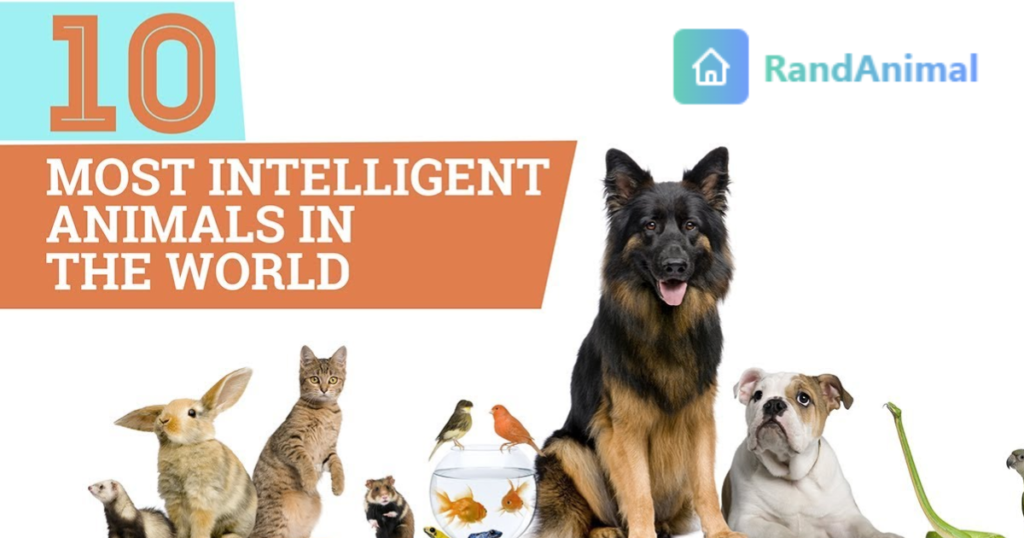
Have you ever looked at an animal and wondered what’s really going on behind those eyes? The truth is, the most remarkable creatures on Earth are far more capable than most people give them credit for. From chimps solving complex puzzles in seconds to pigeons navigating war zones, the breadth of animal cognition continues to astonish researchers worldwide.
This guide explores the smartest animals in the world, backed by real science — covering problem-solving, tool use, memory, and emotional depth. Whether you are a curious reader or a wildlife enthusiast, this article will completely change how you see the creatures we share this planet with. Read More about A Complete Guide to Animal Names.
What Does Animal Intelligence Actually Mean?
Before ranking the most intelligent animals, it is important to understand what scientists are actually measuring. Animal intelligence is not one single thing. It is a rich combination of several abilities that scientists study carefully:
- Problem-solving ability and creative thinking
- Memory and long-term recall
- Communication and language use
- Tool use, planning, and foresight
- Emotional intelligence and empathy
- Self-awareness tested through mirror recognition
Scientists also use the encephalization quotient — a ratio of brain size to body mass — as one measure of cognitive capacity. But modern researchers increasingly focus on behavioral flexibility and social learning, because some of the smartest creatures on Earth have relatively small brains yet outsmart much larger animals with ease.
Understanding animal cognition is a rapidly evolving field, and every year brings discoveries about how deep the minds of animals truly go. With that foundation in place, here are the top 10 most intelligent animals in the world.
The Top 10 Most Intelligent Animals in the World
1. Chimpanzees — Nature’s Closest Mirror to Humans
When it comes to intelligent mammals, chimpanzees sit firmly at the top. Sharing approximately 98% of human DNA, chimps are the gold standard when discussing the smartest non-human animals on Earth.
Their cognitive range is extraordinary. They learn sign language, recognize themselves in mirrors, and form complex social hierarchies. Their problem-solving ability is where things get truly remarkable — in a landmark study published by Inoue and Matsuzawa (2007) in Current Biology, young chimps outperformed adult humans in a rapid short-term memory task, one of the most striking demonstrations of a species exceeding human performance in a specific cognitive domain.
In the wild, chimpanzees craft spears for hunting and use stones to crack open hard nuts. They are textbook tool users not by accident, but through deliberate planning and even teaching younger chimps the same skills.
2. Dolphins — The Social Geniuses of the Sea
Dolphins are arguably the most celebrated intelligent marine animals in the world — and for very good reason. Their cognition is multi-layered, spanning communication, memory, empathy, and problem-solving that continues to surprise marine biologists.
A dolphin’s brain is four to five times larger than expected for its body size, giving it serious cognitive firepower. Self-awareness has been confirmed through mirror recognition — in a study by Reiss and Marino (2001) published in PNAS, bottlenose dolphins not only recognized themselves but inspected marks placed on their bodies, a behavior observed in very few species on Earth.
These social animals live in tight-knit pods, form long-lasting friendships, and pass knowledge down through generations. Female dolphins spend years teaching their calves survival skills, from tool use to hunting strategies. The U.S. Navy has even trained bottlenose dolphins to locate underwater explosive mines, highlighting their extraordinary memory and trainability.
3. Elephants — Emotional Giants with Unmatched Memory
Few animals are as awe-inspiring as elephants. They possess the largest brain of any land animal, weighing around 10.5 pounds and housing approximately 257 billion neurons — a figure documented by Herculano-Houzel et al. (2014) in Frontiers in Neuroanatomy.
Elephant memory is legendary. These animals can recognize up to 30 family members by scent alone, recall migration routes used decades earlier, and remember specific humans — whether friend or threat — after years of separation.
Their emotional depth is equally striking. Elephants mourn their dead, returning to the bones of lost relatives long after death. They console distressed herd members, show visible joy during reunions, and display coordinated group behavior that researchers describe as a sophisticated form of social communication rarely seen outside of primates. They are also accomplished tool users — stripping branches to swat flies and modifying objects for specific purposes.
4. Crows — The Problem-Solvers of the Bird World
Among intelligent birds, crows are in a class of their own. Despite having brains the size of a walnut, their reasoning ability has been compared by researchers to that of a 7-year-old human child (Emery & Clayton, 2004, Science).
Their tool use is perhaps the most dramatic display of their abilities. New Caledonian crows have been observed bending wire into hooks to retrieve food from narrow containers — a behavior requiring an understanding of cause, effect, and the physical properties of materials. Urban crows in Japan have also been seen placing nuts in traffic lanes for cars to crack open, then waiting patiently at the kerb for the light to change before retrieving them.
Crows also recognize specific human faces, warn others in their group about threats, and hold long-term memories of individuals who have wronged them. These capabilities make them arguably the finest example of high avian intelligence on the planet.
5. Orangutans — Strategic Thinkers of the Rainforest
Orangutan intelligence often surprises people, because these quiet great apes rarely seek the spotlight. Yet they demonstrate some of the most advanced strategic thinking found in any species.
In studies measuring planning and tool use, adult orangutans have outperformed human children in certain construction tasks. They weigh costs and benefits when exchanging objects with researchers — a form of reasoning remarkably similar to human economic thinking. Their capacity for long-term planning, rich cultural traditions, and decades-long mother-offspring bonds all reflect extraordinary cognitive depth.
One orangutan named Fu Manchu famously fashioned a makeshift key from wire, hiding it in his mouth between escape attempts from his enclosure at the Omaha Zoo — a story that perfectly captures the quiet cunning of this species. As one of the most gifted great apes on the planet, orangutans deserve far more recognition than they typically receive.
6. Octopuses — The Invertebrate Outlier
Octopus intelligence is perhaps the most mind-bending entry on this list, because octopuses are invertebrates — yet their cognitive abilities rival those of many vertebrates. They are the crown jewel of intelligent marine animals outside of dolphins and whales.
Their problem-solving is well-documented. They navigate complex mazes, open childproof jars, solve multi-step puzzles, and recognize individual human faces despite being colorblind. Research by Mather and Anderson (1993) confirmed that octopuses treat different humans differently based on past interactions — a clear demonstration of long-term individual recognition.
What makes octopus cognition truly unique is their distributed nervous system. Three-fifths of an octopus’s neurons live in its eight arms, meaning each arm functions almost as an independent thinker. Their ability to collect, carry, and assemble coconut shells as portable shelters — documented by Finn et al. (2009) in Current Biology — places them firmly among the world’s tool-using animals.
7. African Grey Parrots — Vocabulary Champions
Among all intelligent birds, the African Grey Parrot stands alone in its mastery of language and abstract thinking. These parrots do not just mimic sounds — they genuinely comprehend meaning.
Alex, an African Grey studied for over 30 years by scientist Irene Pepperberg (documented in her 2009 book Alex & Me), could identify colors, shapes, materials, and count up to six objects. He demonstrated real understanding — not trained repetition. More recently, a parrot named Griffin outperformed Harvard undergraduate students in a visual memory task in research published by Pepperberg and Carey (2012), consistently matching or exceeding college-level performance — one of the most compelling demonstrations of avian cognition in recent scientific history.
African Greys also show remarkable long-term memory, retaining individuals, routines, and complex learned tasks over many years.
8. Pigs — The Most Underrated Smart Farm Animals
Among all farm animals, pigs are the most cognitively advanced — and the most underestimated. Their intelligence genuinely rivals that of dogs and cats, yet pigs rarely receive the same public recognition.
Young piglets can master the concept of mirror reflection in under five hours, using the reflection to locate hidden food — a finding published by Held et al. (2000) in Animal Behaviour. They understand instructions given by humans, learn new tasks on the first attempt, and display measurable emotional sensitivity: research by Mendl et al. (2010) in Current Biology showed that pigs experience optimism and pessimism based on their living conditions, a level of emotional nuance once thought unique to primates.
9. Rats — Tiny Bodies, Mighty Minds
Rat intelligence is supported by decades of scientific research — and the results consistently impress. Rats have successfully colonized every continent on Earth except Antarctica, a feat that speaks volumes about their adaptability and cognitive flexibility.
In laboratory settings, rats solve complex mazes, find shortcuts that human researchers did not anticipate, and show strong long-term recall. Trained rats at the nonprofit organization APOPO have detected tuberculosis in human samples and located buried landmines — completing in minutes tasks that take human experts days to finish.
Studies by Bhatt et al. (2010) have also revealed that rats can distinguish between videos featuring rats and those that do not, and recognize 3D objects even when resized or rotated — cognitive feats once considered far beyond rodent capability.
10. Pigeons — The Underdog of Animal Intelligence
Rounding out the top 10 most intelligent animals is the pigeon — a bird so common it is almost invisible, yet cognitively remarkable. Pigeon intelligence has been studied more thoroughly than almost any other bird, producing a wealth of surprising findings.
Pigeons can recognize hundreds of photographs after years of separation, distinguish between the artistic styles of different painters, perform sequences of learned actions, and identify themselves in mirrors. Their navigation abilities are legendary — for centuries, militaries worldwide used them to carry critical messages during both World Wars, relying entirely on their homing instincts and spatial memory.
Psychologist Edward Wasserman described pigeon learning as a highly effective natural algorithm — consistent, reliable, and far more sophisticated than the bird’s humble street-corner appearance suggests.
Honorable Mentions
The animal kingdom is vast, and several remarkable species narrowly missed the top 10:
- Bonobos — Closely related to chimpanzees, bonobos show extraordinary communication skills, cooperative behavior, and empathy that rivals any primate.
- Whales — Humpback whales use complex collaborative bubble-net hunting techniques that demonstrate advanced group planning among intelligent marine animals.
- Ravens — Like crows, ravens display impressive foresight, self-aware behaviors, and sophisticated social intelligence.
- Dogs — Man’s best friend demonstrates exceptional emotional intelligence and can learn over 1,000 words with the right training.
- Capuchin Monkeys — Expert tool users that learn by observation, capuchins rank among the most resourceful intelligent mammals in South America.
Frequently Asked Questions
What is the difference between animal intelligence and human intelligence?
Human intelligence relies heavily on abstract reasoning, cumulative culture, and advanced language. Animal cognition tends to be highly specialized — a crow’s spatial reasoning or a dolphin’s social memory can surpass human ability in those specific domains, but no non-human species shows the broad, generalized cognitive range that humans possess. Researchers use this distinction to study each species on its own cognitive terms rather than ranking them against a human benchmark.
How do scientists actually test animal intelligence?
Researchers use a range of methods: maze navigation, object permanence tasks, mirror self-recognition, tool-use trials, and social learning experiments. Neuroimaging is also increasingly used to study brain activity in real time. Each method probes a different cognitive dimension, which is why no single test can capture the full picture of a species’ mental capability.
Can animal intelligence evolve over generations?
Yes. Research suggests that social learning — where individuals observe and copy skilled peers — accelerates cognitive evolution. Species that live in complex social groups (chimps, dolphins, elephants) tend to develop richer cognitive toolkits over generations because useful behaviors are passed down culturally, not just genetically.
Why do some animals with small brains show such high intelligence?
Brain-to-body ratio matters more than raw size. Crows and African Grey Parrots have dense neural packing in their forebrains (the nidopallium caudolaterale) that functions analogously to the mammalian prefrontal cortex — the seat of planning and reasoning. This architectural efficiency allows small-brained birds to perform cognitive tasks on par with much larger mammals.
What are the most intelligent animals in the ocean?
Dolphins lead among marine species, followed by orcas (killer whales), sperm whales, and octopuses. Dolphins and orcas share complex social structures, cultural transmission of hunting techniques, and confirmed self-awareness. Octopuses are unique as the only invertebrate on most top-intelligence lists.
Conclusion
The most intelligent animals on Earth remind us that intelligence is not a single, human-owned trait — it is a rich spectrum that spans oceans, forests, farms, and city streets. From the extraordinary memory of elephants to the creative tool use of urban crows, nature has engineered minds that rival our own in endlessly fascinating ways.
Understanding animal cognition — and protecting the remarkable species that possess it — is one of the most important responsibilities humanity carries. These animals think, feel, remember, plan, and communicate. The more science reveals about their inner lives, the deeper our obligation becomes to treat them with the respect they have always deserved.
The smartest animals in the world are not just curiosities. They are a mirror — showing us that the capacity for thought, emotion, and brilliance is one of the most universal gifts life on Earth has ever produced. Our guide on animal types explores vertebrates, invertebrates, habitats, feeding habits, and fascinating facts about the animal kingdom.
Read more: Types of Animals and Amazing Facts You Should Know

Ali is an animal enthusiast and wildlife writer with a passion for making nature science easy to understand. He has been researching and writing about animal behavior and biology for over 3 years.