
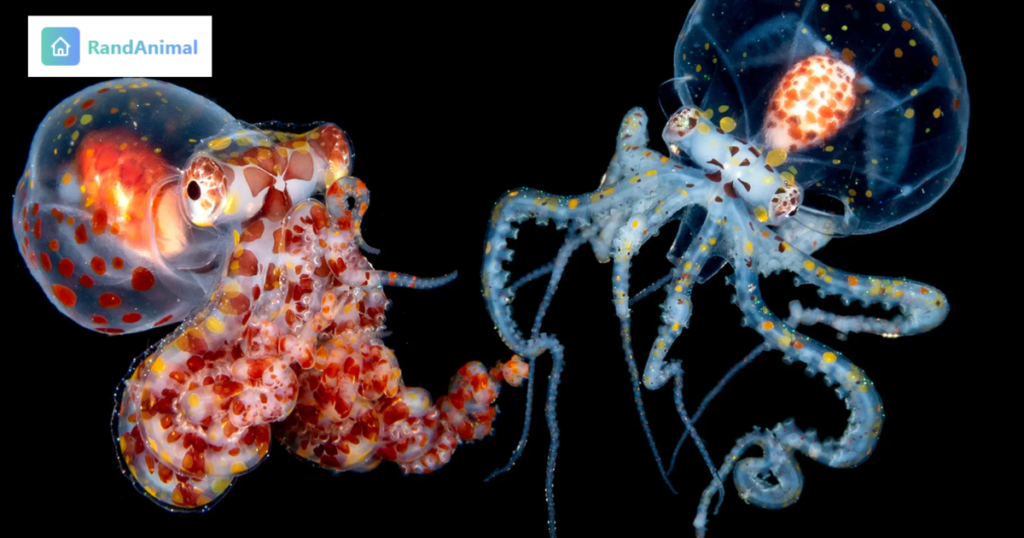
More than 80 percent of the world’s oceans remain unexplored. That is not a rough estimate or an exaggeration. Scientists say this figure is real. It shows that the deep sea is the least understood place on Earth. Humans have reached the Moon and mapped Mars. We have even photographed black holes billions of light-years away.
Yet most of the deep ocean remains a mystery. What lives down there, how it behaves, how it hunts and reproduces, most of it remains unknown. From time to time, a remotely operated vehicle descends into the deep ocean. It carries cameras and lights. Sometimes, it returns with footage that leaves scientists amazed.
It is a creature no one has ever seen alive before. Sometimes, it proves that an animal known only from dead specimens is actually alive. It exists just as scientists hoped. And sometimes it is something entirely new, something that cannot even be classified.
This article explores some of the rarest deep-sea creatures ever caught on camera. It covers the real expeditions, the dates, and why each sighting was so extraordinary. Read More about 10 Deep-Sea Animals That Look Like Aliens.
The World Beneath the Light
Before getting into individual creatures, it helps to understand the environment these animals live in. The ocean is divided into zones based on depth and light. The twilight zone runs from about 650 to 3,300 feet below the surface. Below that is the midnight zone, stretching down to around 13,000 feet. Deeper still is the abyssal zone, and then the hadal zone, found only in the deepest ocean trenches.
As Mental Floss describes it, the twilight zone is a dim part of the ocean. Only a small amount of sunlight reaches it. Faint shadows can still be seen. It is home to some of the most unusual creatures on Earth.
Below the twilight zone, there is no light at all. The pressure is crushing, the temperature is near freezing, and food is scarce. Animals that survive down there have evolved in ways that look almost impossible to anything living at the surface.
Colossal Squid
Few creatures in ocean history have been as sought after, as mythologized, and as stubbornly elusive as the colossal squid. Known scientifically as Mesonychoteuthis hamiltoni, the colossal squid is the heaviest invertebrate on Earth.
Adults can weigh over 1,000 pounds. They have the largest eyes of any living animal. They also have rotating hooks on the club-shaped ends of their tentacles to grip prey.
The species was first named and described in 1925, when researchers found remains inside the stomach of a sperm whale. For the next hundred years, scientists knew the colossal squid only from dead specimens. These washed ashore, were caught by fishing trawlers, or were found inside the stomachs of their predators. The animal had never been seen alive in its natural environment.
That changed on March 9, 2025. According to Scientific American, Researchers aboard the research vessel Falkor (too) were exploring the deep sea. The expedition took place near the remote South Sandwich Islands in the South Atlantic Ocean.
That morning, they deployed a remotely operated submersible to nearly 2,000 feet below the surface. And then it appeared, drifting slowly past the camera, mostly transparent, its tiny fins flapping like wings.
It was a baby colossal squid, measuring just about one foot long. The researchers filmed the animal and continued their dive. They did not realize what they had captured until days later. Glass squid experts reviewed the footage and confirmed the discovery. As Discover Wildlife reported, Dr. Kat Bolstad of Auckland University of Technology called the first footage of a juvenile colossal squid exciting. She also said it was humbling to think the animal had no idea humans existed.
A century after its discovery, the colossal squid had finally been seen alive. It is worth pausing on how long that took. Scientists spent a hundred years studying the colossal squid. They examined specimens, searched whale stomachs, and explored the deep sea. In the end, one lucky camera pass at 2,000 feet captured the first real footage.
The Giant Squid
The giant squid (Architeuthis dux) is a close relative of the colossal squid. It is larger but lighter. Scientists waited many years before capturing it on camera in the wild. According to the Natural History Museum in London, the first photos of a live giant squid in its natural habitat were taken in 2004. Japanese researcher Dr. Tsunemi Kubodera lowered a baited camera into the ocean near the Ogasawara Islands and waited.
An individual appeared, attacked the bait, and left behind a tentacle after a four-hour struggle. As Science magazine reported, It grabbed the lure with its feeding tentacles. It then wrapped the tentacles into a ball. The squid jetted around and dragged the camera 300 meters up and back down. It finally broke free. DNA analysis of the tentacle confirmed an 8-meter Architeuthis.
The first video of a giant squid in its natural habitat was recorded in 2016. Scientists used a glowing, jellyfish-shaped lure to attract it. They believed the light copied the distress signals of bioluminescent jellyfish, which giant squid are drawn to.
It worked. Giant squid can grow up to 43 feet long and weigh about 600 pounds. They are the longest invertebrates on Earth. For centuries, many people believed they were only legends. They may even have inspired the Norse myth of the Kraken.
The Giant Phantom Jelly
The giant phantom jelly (Stygiomedusa gigantea) is one of the largest and rarest jellyfish ever filmed. Scientists first described it in 1910. It can grow up to 33 feet long. It has four broad, ribbon-like mouth arms that help it catch prey and move through the water.
As Oceanographic Magazine reported, the species had been seen only about 100 times. Scientists at MBARI later filmed it using the robotic rover Doc Ricketts at a depth of 3,200 feet. The HD cameras and LED lights captured details of its appearance and movement that dead specimens could never reveal.
The reason these creatures are so rarely spotted is partly a matter of technology and partly a matter of where they live. For most of the history of marine biology, scientists relied on trawl nets to collect deep-sea specimens. MBARI researchers explain that nets work well for fish, crustaceans, and squid. However, jellyfish often turn into gelatinous mush when they are brought to the surface.
The only way to observe them properly is with cameras deployed into their actual environment. Even with ROVs now operational for decades, encounters with the giant phantom jelly remain extraordinarily rare.
The Bigfin Squid
The bigfin squid, genus Magnapinna, was not even recognized as its own group until ROV footage captured it in the Gulf of Mexico in 1998. Before that sighting, scientists had a few juvenile specimens that did not match anything known.
The footage showed something that looked almost impossible. The squid had extremely long arms and tentacles. They stretched outward at almost right angles from its body. They then hung straight down in long, trailing threads.
According to Live Science, bigfin squid can grow to around 20 feet in total length, mostly due to those trailing arms and tentacles, which can extend up to 20 times the length of the squid’s body itself. The NOAA confirms that the elbow-like bends in the arms are a feature unlike anything seen in other squid species.
Sightings remain rare. Scientists have filmed it in deep waters across several oceans. However, its behavior, diet, and life cycle remain largely unknown. No adult specimen has ever been physically collected and studied. What scientists know about this animal comes almost entirely from those brief camera encounters in the dark.
The Barreleye Fish
The barreleye fish, Macropinna microstoma, is one of those creatures that seems too strange to be real. Its most distinctive feature is a completely transparent dome that forms the top of its head. Inside that dome sit two luminous green tubular eyes that typically point upward, allowing the fish to spot the silhouettes of prey above it in the water column.
For years, scientists who had seen dead barreleye fish in laboratories assumed the transparent dome was just the fish’s normal head and that the eyes faced forward. It was only when MBARI filmed a live barreleye in its natural habitat in 2009 in the Monterey Submarine Canyon that the full picture became clear.
In the footage, the dome is completely transparent, and the eyes are unmistakably pointing upward. The fish can apparently rotate its eyes to face forward when it is about to feed. As A-Z Animals explains, barreleye fish are typically found between 2,000 and 2,600 feet below the surface, where they feed on small crustaceans and organisms caught in the tentacles of siphonophores.
Before the MBARI footage, no one had ever seen a living barreleye with its dome fully intact. The transparent structure collapses almost immediately when the fish is brought to the surface, which is why decades of specimens gave scientists an incomplete picture of what the animal actually looked like while alive.
The Goblin Shark
The goblin shark, Mitsukurina owstoni, has been known to science since 1898, when a specimen was brought up by fishermen in Japan. In the more than 125 years since then, virtually everything scientists learned about it came from dead individuals hauled accidentally from the deep.
It is one of the most unusual sharks alive, with a long flat snout that makes up about a tenth of its total body length and, most remarkably, a jaw that shoots forward at extraordinary speed to catch prey. According to Science Focus, the jaw strikes at 3.1 metres per second, which is fast enough to snatch a fish before it has any chance of reacting.
The hooks and suction created by the extending jaw are unique among sharks, and the mechanism has been studied from preserved specimens for decades without anyone ever seeing it happen in real life.
That changed with footage captured first in 2019 near Jarvis Island in the South Pacific by a team from the University of Hawaii at Manoa, and then again in 2024 near the Tonga Trench by the Minderoo University of Western Australia Deep Sea Research Center.
As Live Science reported, the lead researcher on the 2024 sighting said he never thought they would see one alive. The Tonga Trench individual was also found swimming about 2,300 feet deeper than any goblin shark had ever been recorded before, at around 6,550 feet below the surface.
The Frilled Shark
The frilled shark, Chlamydoselachus anguineus, looks less like a shark and more like an eel with teeth. Its body is long and cylindrical. Its mouth opens at the very front of its head rather than underneath, like most sharks. It has six frilled gill slits that give it its name, and it carries 300 trident-shaped teeth arranged in 25 rows.
As TheSea.org explains, scientists who first encountered this animal in the 1880s were genuinely uncertain what they were looking at. It has remained essentially unchanged for tens of millions of years, which is why it is commonly described as a living fossil.
Its reproductive biology is also remarkable. The frilled shark has the longest pregnancy of any known vertebrate, with a gestation period estimated at around three and a half years. African elephants, which carry their young for about 22 months, are nowhere close.
Despite being described in the 1800s, the frilled shark was only rarely filmed alive near Japan in 2007. Even today, live sightings are extremely uncommon. Most encounters happen when individuals are accidentally caught during fishing operations at depth, and they rarely survive the ascent to the surface. Their behavior in the wild, how they hunt, how they spend their time, remains largely a mystery.
The Black Seadevil Anglerfish
The anglerfish is one of the most recognizable deep-sea creatures in popular culture, known for the bioluminescent lure dangling from its head and the extreme sexual dimorphism that sees tiny males permanently fuse their bodies to the much larger females.
But despite being well known from specimens and illustrations, a living female black seadevil anglerfish in its natural habitat had never been filmed until 2014. MBARI researchers captured the footage at 1,900 feet below the surface off the coast of California.
It was the first time anyone had ever seen a live female anglerfish of this species in the wild, and the footage showed its glowing lure pulsing softly in the darkness.
The animal is only about 3.5 inches long in the footage, but the encounter was described as extraordinary precisely because of how long it had taken to achieve it. As Tynemouth Aquarium notes, the anglerfish typically lives in the midnight zone, with some species venturing even deeper. Getting cameras into that zone with enough resolution and light to document behavior has been the challenge for decades.
The Dumbo Octopus
The dumbo octopus is a group of deep-sea octopuses in the genus Grimpoteuthis. The name comes from the two prominent ear-like fins on either side of their bell-shaped bodies, which resemble the famous ears of the Disney character. They are semi-translucent, gelatinous in appearance, and they move by flapping those fins in combination with pulsing their arms and using water jet propulsion.
According to Tynemouth Aquarium, dumbo octopuses have a single line of about 65 to 68 suckers along each arm, and their gelatinous bodies allow them to withstand the extreme pressures found in their habitat. Unlike most octopuses, they have no ink sac, which makes sense given that at their depths, there are very few predators to spray ink at.
NOAA submersibles have filmed dumbo octopuses at depths over 3,000 metres across multiple Pacific expeditions, making them one of the more documented deep-sea animals on this list, though individual sightings remain uncommon given how little time research vehicles spend at those depths.
An Unidentified Animal
Perhaps the most extraordinary sighting in recent memory came not from a known but elusive species, but from something that could not be identified at all. In early 2026, as Discover Wildlife reported, researchers dropped cameras to 9,100 metres below the ocean surface off the coast of Japan and captured footage of a creature so unusual that scientists could not classify it.
The strangely shaped, whitish creature was recorded floating through the extreme depths and was given the temporary scientific label Animalia incerta sedis, meaning an animal of uncertain placement.
Researchers initially thought it might be a nudibranch, a type of sea slug, because its body appeared to be divided into two symmetrical halves with antennae-like projections similar to features seen on sea slugs.
But they could not confirm it, and the study was published in the Biodiversity Data Journal with the creature still unclassified. It remains one of the clearest examples of how much the deep ocean still has to show us.
The Giant Siphonophore: Longest Animal
Siphonophores are not individual animals. They are colonies of smaller organisms called zooids, each one specialised for a different function, some for movement, some for feeding, some for reproduction. Together they form a single colony that functions like one creature, and in the case of the giant siphonophore, that colony can reach extraordinary lengths.
In 2020, the Schmidt Ocean Institute documented what was described as the longest animal ever recorded during a deep-sea expedition off Western Australia. The specimen observed by ROV was estimated at around 150 feet in total length, longer than a blue whale. The footage, published widely by the scientific community, showed the creature arranged in a spiral formation in the water column, something that had never been captured on camera before.
Why So Few Have Been Filmed
Looking at this list, one thing stands out. Many of these animals have been known to science for over a century, sometimes much longer, yet footage of them alive in their natural environments is extremely recent and extremely rare.
The frilled shark was named in the 1880s and was only filmed alive in 2007. The colossal squid was identified in 1925 and not filmed until 2025. The goblin shark has been known since 1898 and was only observed alive in its natural habitat within the last few years.
The reason is almost entirely a matter of technology and money. Deep-sea ROVs capable of reaching extreme depths are expensive to build, expensive to operate, and require large research vessels to deploy them.
For most of the twentieth century, marine biologists had almost no tools for observing life below a few hundred metres without disturbing or killing whatever they were studying. Trawl nets brought up dead or dying specimens, and pressurised containers destroyed the delicate body structures of soft animals like jellyfish and squid.
Modern ROVs with high definition cameras, sensitive LED lighting, and the ability to maintain position at depth for hours at a time have changed everything. Organisations like MBARI, the Schmidt Ocean Institute, and NOAA have been responsible for most of the extraordinary footage gathered in recent decades.
What Comes Next
Scientists estimate that the deep sea contains millions of species that have not yet been described or named. Every expedition that reaches the hadal zone, the deepest ocean trenches beyond 6,000 metres, returns with footage or samples that add new pieces to the picture. The unidentified creature filmed at 9,100 metres off Japan in 2026 is a reminder that genuine discoveries are still happening all the time.
The creatures in this article are not curiosities from the edges of science. They are real animals living full lives in one of the most extreme environments on Earth. The fact that we have only just begun to see them on camera is not a sign of their strangeness but of how limited our tools have been and how vast the ocean really is.
As technology improves and more expeditions are funded, the list of deep-sea creatures caught on camera will grow, and almost certainly some of what gets filmed will be something no one has ever imagined.
FAQs
1. Why are deep-sea animals so rarely seen on camera?
Deep-sea animals live in extreme depths where there is no sunlight, very high pressure, and very low temperatures. These conditions make exploration very difficult, so only a few animals are ever recorded during special research missions.
2. Are all deep-sea creatures already discovered?
No. Scientists believe a large number of deep-sea species are still undiscovered. The ocean is vast, and only a small part has been explored with modern equipment.
3. How do scientists film animals in the deep ocean?
They use special tools like underwater robots (ROVs), deep-sea submersibles, and pressure-resistant cameras. These devices can survive extreme pressure and record video in complete darkness.
Final Thoughts
The deep ocean remains one of the least explored ecosystems on Earth. According to marine science estimates, a large percentage of deep-sea species are still undiscovered or poorly studied. Each verified footage of these rare animals provides valuable scientific data that helps researchers better understand life under extreme conditions.
There are still many unknown species waiting to be discovered, and future deep-sea exploration will continue to expand our knowledge of ocean life. Read More: Top 10 Scariest Deep Sea Animals Ever Discovered.

Ali is an animal enthusiast and wildlife writer with a passion for making nature science easy to understand. He has been researching and writing about animal behavior and biology for over 3 years.